
Diversity, youth and future-oriented standardization—Interview with Rachel Miller Prada, ISO Capacity Building Project Manager
标准化工作要着眼于多样化、年轻人和未来——专访ISO能力培养项目经理 瑞秋·米勒·普拉达
China Standardization: Can you please briefly introduce ISO, its international standards as well as your scope of work?
Rachel Miller Prada: ISO is an independent non-governmental organization dedicated to developing international standards. Currently, ISO has 175 member bodies, representing 175 countries that participate in its standard development work. We have a portfolio of over 24,000 international standards, with around 100 new standards issued or existing ones revised every month.
The ultimate goal of our standardization work is to support the achievement of the United Nations Sustainable Development Goals (SDGs). Every standard we develop and every task I undertake in my role contributes to these global objectives.
ISO international standards are designed to advance clean energy access, safe drinking water supply, quality of life improvement, gender equality, food security and more—all of which are pivotal to realizing the SDGs.
ISO’s strategic framework is built around three core pillars, one of which is ensuring all voices are heard. To this end, we prioritize the participation of women, young professionals and representatives from developing countries in standardization processes. We have compiled data on the age distribution of technical experts involved in ISO’s work worldwide, as shown in Figure 1-2.
Unsurprisingly, the majority of ISO technical committee members are 45 years old or above. What I would like to draw your attention to, however, are two age groups: professionals under 25, and those aged 35-44. At ISO, a “young professional” is defined as someone 35 years old or younger and there is a striking underrepresentation of young talent in our standardization work.
Notably, among younger technical experts, women account for a larger share of participants. But as the age of experts increases, this trend reverses, with men becoming the majority in ISO technical committees. The participation rate of women aged 25-30 drops sharply, and many women exit the field of standardization altogether at this stage.
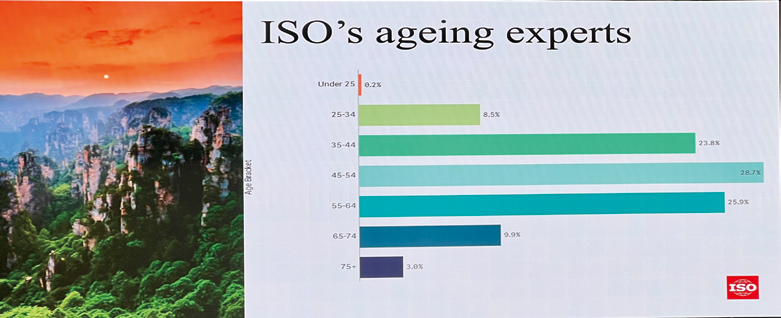
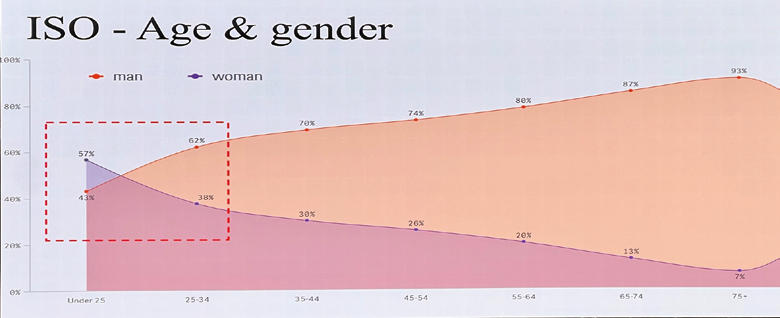
Figure 1-2: The age distribution of technical experts involved in ISO’s work worldwide
While we cannot pinpoint the exact reasons, we can make reasonable assumptions about the life changes women experience around this age—marriage, child-rearing and shifting life priorities, all of which are completely understandable. The critical issue is that once women leave the technical domain, they rarely return. This raises key questions for us: How can we retain women in standardization work? What barriers can we remove to facilitate their participation? And how can we attract them back to the field after stepping away?
It is also interesting to look at the data from China. Chinese technical experts participate in ISO’s work at the international level, and we observe the same trend: a large number of young women engage in technical standard development initially, but their participation rate declines significantly over time, with most not returning to the field after leaving.
This is a challenge ISO is actively addressing. We recognize the problem and are exploring solutions to keep women engaging in standardization work, or to encourage their return after their childbearing and family-focused years.
In terms of supporting our members to attract and engage young professionals in standardization, we have launched an education program that serves as a platform for knowledge and experience sharing. Many ISO members are already making substantial efforts to involve young professionals and students in standardization activities—but we need to enable collective learning and peer-to-peer knowledge exchange across the global network.
I am pleased to note that the International Standardization Outstanding Contribution Award Foundation and SAC in China are doing excellent work in this regard as part of the network.
As part of the education program, we have developed a game called Standard Quest to engage young audiences. It is a fun, dynamic and completely free tool that helps users understand ISO international standards and their impact on daily life. You can download and play the game via this link: https://standardquest.iso.org/app/. A Chinese version of the game is also available—feel free to play it with your friends, colleagues and family members.
Why is it so important to attract young people to engage in standardization work?
Rachel Miller Prada: Standardization is a never-ending endeavor. As technology advances and new social and technological needs emerge, we require technical expertise from every sector, because standards touch nearly every aspect of our lives. We must continuously cultivate and engage the next generation of talent, as they are the future of this field.
Young people bring fresh perspectives, innovative ideas and insights into emerging standardization needs. Engaging them at an early stage allows them to contribute to standardization throughout their entire professional careers.
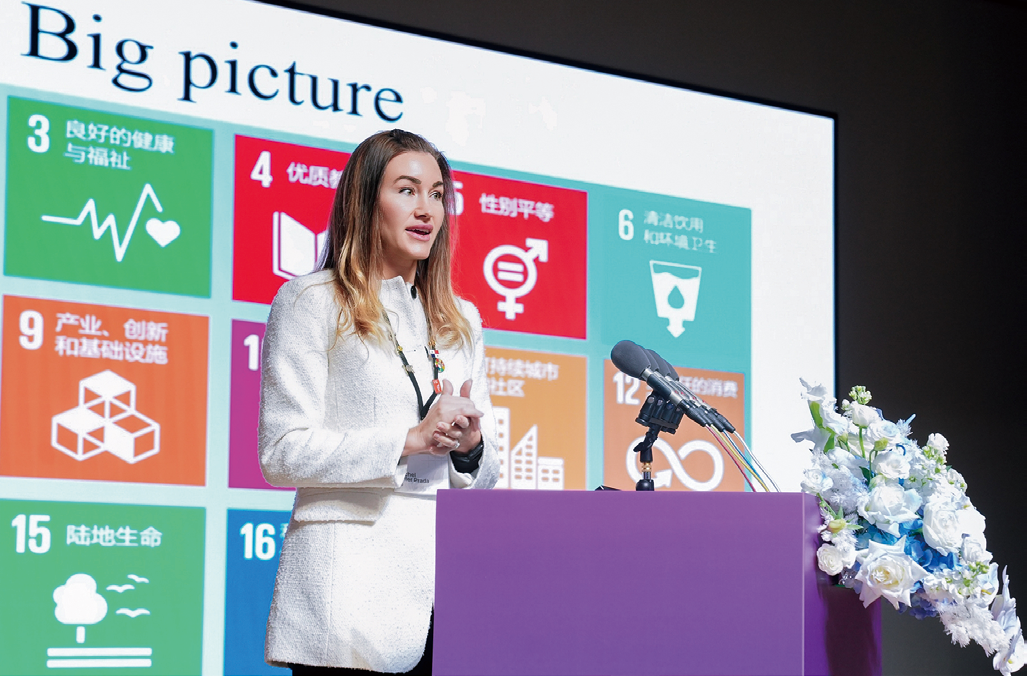
Rachel Miller Prada delivers a speech at the International Standardization Youth Star Competition 2025 in Qingdao, China.
For young people, what benefits can they gain from learning more about standards and participating in standardization activities?
Rachel Miller Prada: First, from ISO’s perspective and that of our members, young people inject new experiences and ideas into the standardization community. This helps us stay attuned to evolving trends, emerging technologies and shifting societal interactions.
Second, for young professionals themselves, expertise in standardization is a highly marketable skill that sets them apart from their peers. Standardization is a specialized field, and many companies participate in ISO’s standard development work at the international level. Having the experience of sitting at the technical table with these companies equips young professionals with in-depth knowledge of standard development—knowledge that becomes a valuable asset when applying for jobs or attending interviews, opening doors to more career opportunities.
What is your opinion of this year’s International Standardization Youth Star Competition?
Rachel Miller Prada: I have been fortunate enough to be involved in this competition since its very inception. I have witnessed its growth year after year: more student participants, new thematic tracks and growing pride and satisfaction among the organizing foundation and team. The competition has enormous potential and continues to expand, even its venue rotates among different cities each year. I am very much looking forward to watching its continued growth in the years to come.
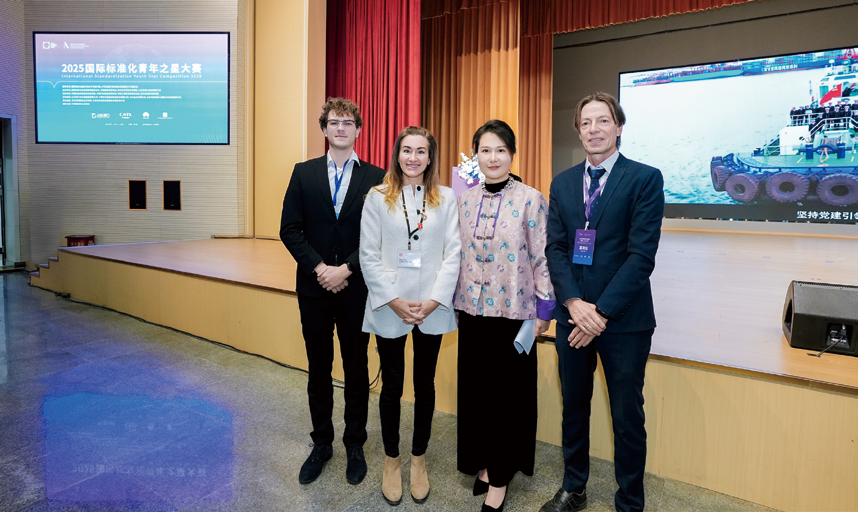
From left to right: Erik Vladimir Simić, SIST Young Standardization Ambassador, Rachel Miller Prada, Xu Shanshan, Secretary-General of International Standardization Outstanding Contribution Award Foundation, Tom Heilandt
What advice would you give to university students who aspire to work at international organizations like ISO? What skills are the most important?
Rachel Miller Prada: When it comes to working at international organizations, English proficiency is a fundamental skill. Standardization work at ISO is conducted primarily in English, so you need to be able to articulate your experiences and ideas clearly and concisely in the language.
Given the international nature of the sector, you will interact with people from all over the world—inpiduals with different ways of thinking and expressing themselves. It is crucial to be comfortable in such perse environments, respect these differences and view them as opportunities to broaden your horizons and enrich your own experiences, rather than seeing them as barriers.
I have noticed that some Chinese university students are relatively shy and struggle with public speaking. I think this is a common issue among the younger generation globally, as people are increasingly reliant on mobile phones and computers for communication, leading to a decline in face-to-face interactions. This is not unique to China, it is a phenomenon we see across Europe, the United States, Australia and beyond.
It is important to remember that standardization work is about engaging with people, not machines. When you sit around the table with other experts, the goal is to reach a consensus. This requires the ability to adapt to different cultures and languages—a key skill in standardization work. Unfortunately, there is no shortcut to developing this skill; it takes time and practice to become comfortable. Public speaking, for example, is a skill that improves only with deliberate practice. There are no secrets to mastering it. You just need to keep practicing until you feel confident.
