
The AI standardization technical committee of Ministry of Industry and Information Technology (MIIT/TC 1) held its plenary meeting recently in Beijing, where a series of achievements were released, marking China’s efforts to build an open, collaborative, intelligent and efficient new standardization ecosystem.
Xie Shaofeng, Chief Engineer of MIIT, addressed the event. He pointed out that the technical committee should clarify the new tasks under the new circumstances, drive technological progress through standards, accelerate the evolution of products, enhance the intelligence level of enterprises, and accelerate the establishment of an industrial ecosystem. Future work will focus on promoting the processes of standards research, proposal, development, release, promotion, implementation, and evaluation. It is expected to become an advanced technical committee to lead technological innovation, regulates industry development, serve the national strategy, and have international influence, transforming standards achievements into a powerful driving force for the high-quality development of China’s AI industry.
The two fundamental public service platforms, namely the global AI standards library and the global AI terminology library, debuted at the event. The standards library has included over 220 relevant Chinese AI standards at national and sectoral levels, with over 840 relevant standards approval information of international standardization organizations such as ITU, ISO, IEC, and IEEE. The terminology database collects over 1,200 AI-related terms, and comprehensively presents the core definition and application scope of AI, providing authoritative basis for standards drafting.
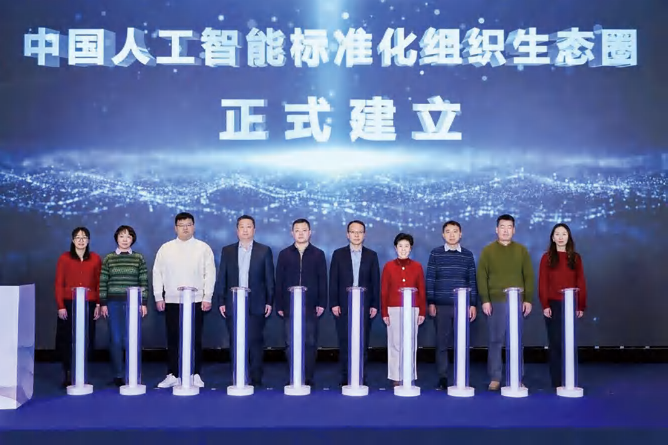
Fruitful results including the first AI agent for standards review, a sectoral standard for the assessment of embodied AI, and the report on AI standardization development were released at the event. Also, the China Artificial Intelligence Standardization Organization Ecosystem was established to break down organizational barriers and promote the harmonization among national, sectoral and association standards.
