
How to design a roadmap for stakeholder engagement in standardization development
如何设计利益相关方参与标准制定的路线图?
By Dr. Zaki Al-Rubaei
文/扎基·阿尔-鲁贝伊

Introduction: From rules to participation
Today, standardization is no longer just about unifying technical terms or setting measurements. It has become a strategic tool to build trust, strengthen competitiveness, and drive sustainable economic growth. As industries grow more complex and new technologies and regulations emerge, it is more important than ever to involve all key players: manufacturers, suppliers, consumers, academics, and regulators. Their shared knowledge and input help shape the standards and policies that guide markets, protect consumers, and ensure product quality and safety.
Although concerns are sometimes voiced about “conflicts of interest” when involving the private sector, global experience demonstrates that exclusion is more harmful than overlap. In fact, structured transparency and institutionalized participation are the surest ways to establish an effective and integrated standardization framework.
Consequently, stakeholder engagement has evolved from being a procedural choice to becoming an ethical and strategic imperative, ensuring that public policies and standards are grounded in both realism and credibility.
Therefore, it has become essential for standardization bodies to adopt a clear, structured, and sustainable roadmap that defines how stakeholders are involved in every phase of standards development and implementation.
The philosophy of participation in standardization
The success of any standardization system depends largely on the breadth and persity of those contributing to its development. While every standard or regulation typically begins as a technical draft, it only matures through continuous dialogue, negotiation, and consensus-building among the various parties involved.
Designing a roadmap for stakeholder engagement is thus not limited to gathering feedback or conducting surveys; it is a deliberate strategic process that requires careful planning, in-depth situational analysis, and balanced management of relationships and interests.
The aim of such a roadmap is to transform stakeholder participation from an occasional interaction into an institutional culture, deeply embedded in the organization’s operations and decision-making. To achieve this, any successful engagement model must rest on three fundamental pillars that together ensure inclusiveness, credibility, and long-term impact.
Core pillars of effective stakeholder engagement
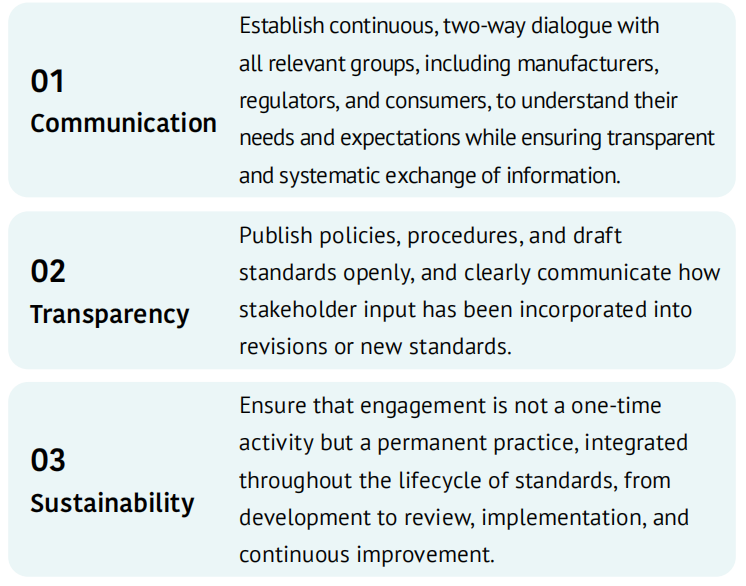
By adhering to these three principles, standardization organizations can foster trust, legitimacy, and shared ownership of the standards they develop.
Stages of building a stakeholder-engagement roadmap
A well-designed roadmap follows a structured, cyclical process consisting of four interconnected stages. Each stage feeds into the next, forming a continuous learning and improvement loop.
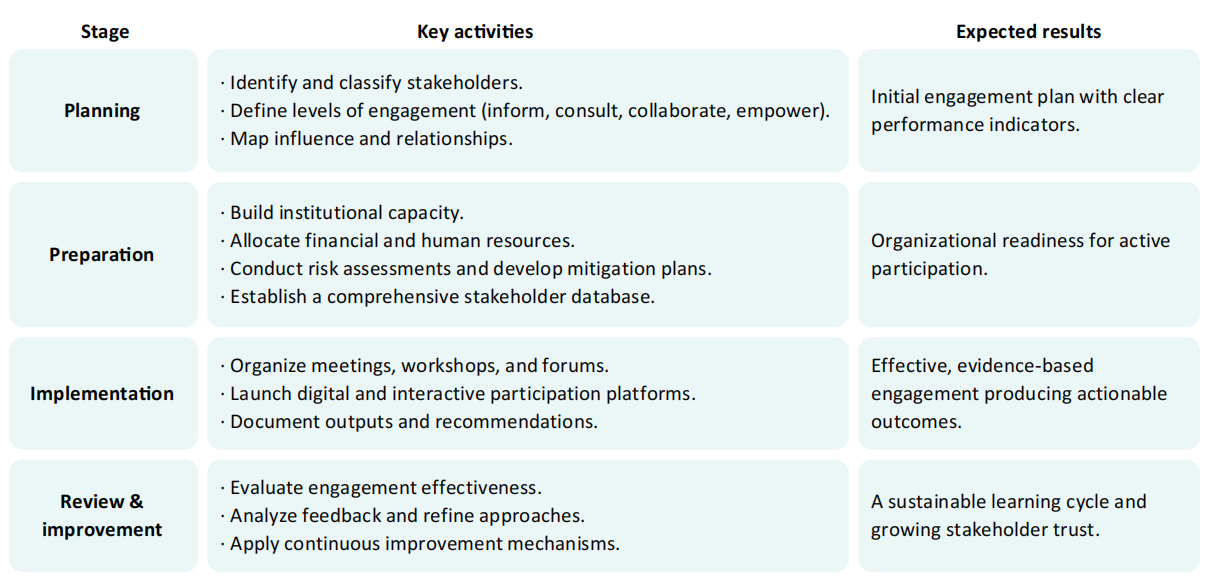
These stages are not isolated steps but rather an integrated process that promotes the continuous flow of knowledge, dialogue, and innovation between standardization bodies and the industrial community.
Stakeholder analysis: Identifying who and why
To manage participation effectively, organizations must first understand who their stakeholders are and what drives their involvement. This begins with mapping and categorizing stakeholders according to their relationship, influence, and interest:
• Primary stakeholders: manufacturers, importers, testing laboratories, conformity assessment bodies, and regulators.
• Secondary stakeholders: universities, professional associations, consumers, media, and NGOs.
By creating an influence–interest matrix, decision-makers can prioritize which groups to engage and at what intensity. Such analytical tools help channel institutional efforts toward areas that generate the greatest impact for the industrial and economic ecosystem.

From consultation to empowerment
Stakeholders’ participation evolves along a continuum, from passive information sharing to full empowerment in decision-making. Understanding this progression allows organizations to apply appropriate engagement tools at each level:
• Inform: Provide information without expecting a response.
• Consult: Request feedback on specific issues.
• Involve: Engage participants in analyzing options and crafting solutions.
• Collaborate: Partner to design and implement joint initiatives.
• Empower: Grant stakeholders a tangible role in shaping policies and standards.
Remember that empowerment means: Integrating stakeholder participation into governance, decision-making processes, and related matters.
Each level demands distinct communication tools, from technical forums and surveys to targeted consultations and co-creation workshops.
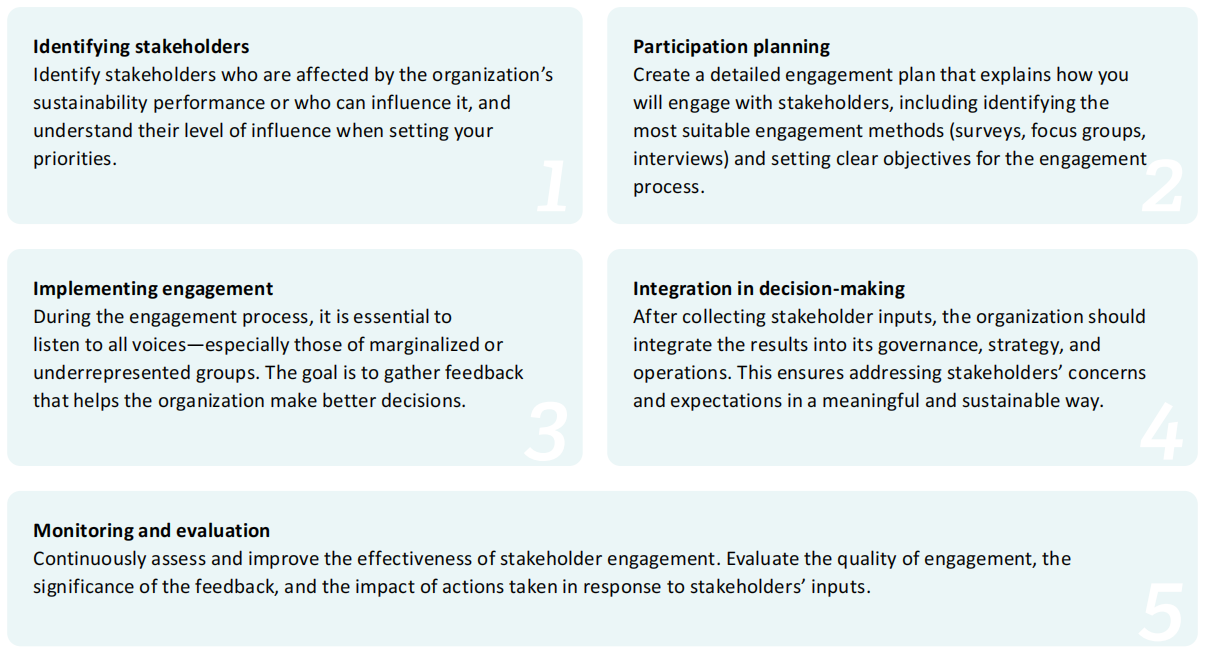
Stakeholder engagement process for sustainability in five steps:
Tools and channels of engagement
The effectiveness of a stakeholder roadmap lies in persifying communication methods to reach all relevant audiences. Examples include:
• Dialogue seminars and open discussion sessions.
• Online surveys and digital consultations.
• Professional media platforms and social networks.
• Joint workshops with industrial and academic partners.
• Regular newsletters and technical follow-up reports.
These tools are not just communication mechanisms; they serve as bridges of trust, enabling stakeholders to participate meaningfully in shaping a transparent and inclusive standardization ecosystem.
Measuring engagement and using feedback
To institutionalize participation, organizations must establish a clear evaluation framework assessing both the quality and impact of engagement. This involves measuring:
1. Outputs: activities completed and documents produced.
2. Outcomes: improvements in understanding, collaboration, and satisfaction levels.
3. Impact: long-term transformation in performance, trust, and transparency.
A structured feedback loop ensures that lessons learned are reintegrated into policies and procedures, promoting institutional maturity and adaptive resilience.
Challenges and opportunities
Although involving stakeholders brings many benefits, it also comes with some challenges.
Some participants may have different levels of technical knowledge, and some organizations may lack the capacity or experience to manage participation effectively. Others may resist change or prefer limited openness, and it can sometimes be hard to balance different interests.
At the same time, new technologies such as digital tools, artificial intelligence, and online platforms are creating great opportunities. They make participation easier, faster, and more inclusive than ever before.
Conclusion: Standardization as a platform for collaboration
Designing a roadmap for stakeholder engagement is not merely an administrative procedure; it is a strategic vision grounded in the belief that quality cannot be imposed; it must be built through partnership.
The broader the participation, the more resilient and relevant the standardization system becomes. Effective standards emerge from dialogue, consensus, and shared ownership, reflecting the evolving needs of markets, industries, and societies.
Ultimately, the goal is to transform standardization into a collective learning process, a space where every stakeholder contributes expertise, every voice is heard, and every decision resonates with trust and inclusivity. Successful standardization is not only written in committees—it is forged through dialogue and built on trust.
About the author:
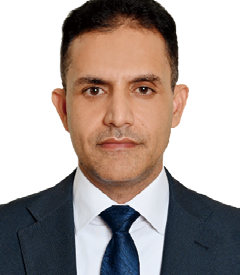
Dr. Zaki Al-Rubaei serves as Head of International Cooperation at the GCC Standardization Organization (GSO) in Riyadh, Saudi Arabia. He holds a PhD in Management Sciences, with specialization in Leadership and Organizational Development, and has more than 27 years of professional experience, including over 18 years dedicated to regional and international standardization.
Throughout his career, Dr. Al-Rubaei has played a key role in strengthening the Gulf standardization system and expanding its global engagement. He has led and coordinated international cooperation with more than 83 regional and international organizations, including ISO, IEC, WTO, ITU, CODEX, and UNIDO, and has represented GSO in numerous high-level international forums and negotiations.
His professional focus lies at the intersection of standardization, trade facilitation, institutional development, and sustainable development. In parallel with his executive responsibilities, he is an author, writer, and certified trainer and consultant. He has directed several training and capacity-building units and has delivered numerous professional programs in leadership, management, and standardization at regional and international levels.
