
Smart technical regulations: When regulation becomes a driver of innovation and competitiveness
智慧技术法规有助于推动创新和提升竞争力
By Dr. Zaki M. Al-Rubaei, Head of International Cooperation, GCC Standardization Organization (GSO)
As global markets become more digital, interconnected, and risk-sensitive, technical regulations are being reshaped from static compliance tools into dynamic systems that learn, adapt, and enable innovation. This article explores how smart technical regulations are redefining the future of standardization and quality infrastructure worldwide.
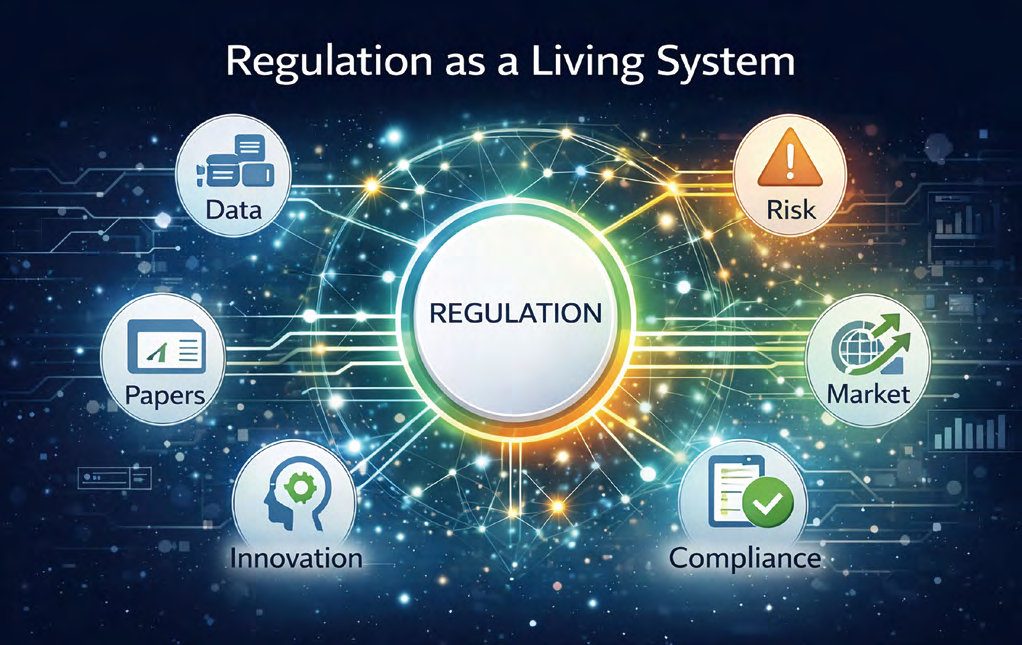
Introduction
Technical regulations are no longer tested only by how strict they are, but by how intelligently they respond to change. In a world shaped by disruptive technologies, fast-moving innovation, and deeply interconnected supply chains, old regulatory approaches are being challenged like never before. What once seemed sufficient for control and compliance may no longer be enough for a global economy that is constantly shifting. This raises a pressing question for policymakers: can traditional frameworks in standardization and quality still keep up with the speed and complexity of today’s world?
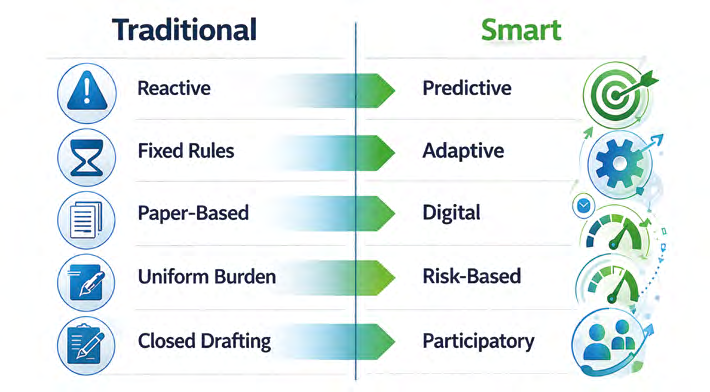
The question becomes even more urgent in today’s digital economy, where industries increasingly overlap, risks change rapidly, and new applications in artificial intelligence, the Internet of Things, blockchain, and biotechnology are advancing faster than legal frameworks can follow. In this fast-moving environment, the idea of smart technical regulations is emerging as one of the most important quiet shifts transforming standardization and quality systems around the world. It is not just about updating laws. It signals a deeper change in how regulation is understood—from a system that reacts to yesterday’s problems to one that anticipates tomorrow’s challenges, and from a rigid framework built on fixed rules to a more flexible model that learns from data, responds to reality, and adjusts its level of intervention based on risk and impact.
From traditional regulations to smart regulations
Historically, technical regulations were designed to protect consumers, ensure product quality, prevent risks, and guide markets. However, the expansion of international trade, the growing level of technical complexity, and the increasing overlap between products and services have required regulation to play a broader role than mere oversight. Today, technical regulations in standardization and quality are no longer simply compliance instruments; they have become part of the infrastructure of innovation and a key factor influencing trade flows, investment attractiveness, and market confidence.
The fundamental distinction between the two models is that traditional regulations were generally built around the question: what happened, and how can we prevent it from happening again? Smart regulations begin with: what might happen, and how do we prepare for it? For this reason, they are built on data, continuous analysis, periodic review, impact assessment, and openness to stakeholders, which makes them more capable of adapting to changing risk patterns and rapidly evolving environments. They do not begin with rigid legal texts, but with operational reality, market behavior, and actual indicators of performance and compliance.
In this context, practical transformations such as digital conformity files, remote inspection or testing through the Internet of Things, real-time cloud-based oversight, and the use of blockchain technology to trace supply chains have become increasingly familiar. These are not merely supporting technical tools; they have become essential components of smart technical regulations because they reduce costs, improve regulatory efficiency, increase data reliability, and accelerate market access for products.
The world is re-engineering regulation
This trend is no longer confined to intellectual or academic debate; it has materialized in advanced international practice. In the European Union, the methodology of legislation has been restructured through forward-looking impact assessments, broad public consultations, and periodic legislative reviews, reflecting a shift from intention-based regulation to outcome-based regulation. The EU AI Act stands out as a global example of this approach, as it relies on risk classification and introduces different levels of requirements depending on the degree of risk, rather than imposing one uniform set of rules on all applications. This approach demonstrates that regulatory intelligence does not mean weakening protection, but directing it with greater precision.
In the United States, the Food and Drug Administration and the Federal Aviation Administration rely on big data analytics and artificial intelligence models to determine inspection priorities and identify higher-risk facilities, thereby reducing random inspections and improving regulatory efficiency and consumer safety. In addition, the concept of behavior-based technical regulations has emerged in certain sectors, where rules are designed based on consumer behavior in order to limit misleading practices and excessive complexity. The value of this model lies in making regulation more closely aligned with the actual behavior of market actors and more effective in terms of outcomes.
China, for its part, has distinguished itself in this field through regulatory sandboxes, which allow new technologies to be tested within defined regulatory environments before moving to full legislative adoption. As demonstrated by Shanghai’s experience with autonomous vehicles, this approach has shown that regulation can serve as a partner to innovation rather than an obstacle to it, and that testing new solutions within structured environments makes it possible to build regulations that are more precise, more balanced, and more closely aligned with practical realities.
In Australia, performance-based regulations have been adopted in the heavy transport sector. Instead of imposing fixed dimensions and detailed technical requirements on trucks, companies are required to demonstrate through simulation and analysis that the vehicle meets the required level of safe performance. Here, regulatory intelligence is expressed in freeing innovation from rigid formal constraints while maintaining safety as the binding outcome.
What unites these experiences is that the transformation is no longer merely about improving tools, but about rethinking the underlying methodology itself. The question is no longer simply how to draft a law, but rather: for what reality are we drafting it? Are we regulating for a rapidly fading present, or are we building rules capable of engaging in the future? Should technical regulations be rigid from the outset, or should they be open to experimentation, review, and evolution? The world is now moving toward a new model of governance based not only on control, but on understanding, anticipation, and continuous learning.
What kind of future do smart regulations produce?
The future of technical regulations and legislation in standardization and quality infrastructure is now tied to their capacity to learn. Regulations that are issued once and revised only after many years are no longer sufficient in an environment that changes with unprecedented speed. Countries that lack continuous mechanisms for reviewing their regulations will find themselves out of step with the markets. Smart regulations, therefore, are neither an intellectual luxury nor a passing trend. They are a structural response to profound global transformations and a necessary step toward building legislative systems that lead the future rather than chase it.
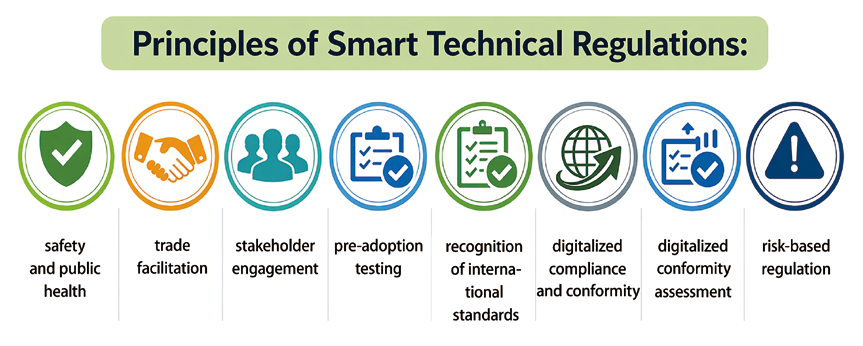
The world is moving toward a new model for the governance of regulation, characterized by greater flexibility, closer integration with technology, and a clearer connection to actual performance outcomes. In this model, data becomes infrastructure for decision-making, enabling the anticipation of risks, the more accurate measurement of compliance, and the issuance of regulatory judgments grounded in evidence rather than impressions. These regulations also rely on international standards such as ISO, IEC, ITU, and CODEX as recognized pathways to compliance, while focusing on verifying required results rather than imposing a single prescribed method of implementation.
Digital transformation is the cornerstone of this model. Compliance systems are shifting from slow paper-based procedures to integrated digital platforms that enable intelligent inspection, near-instant licensing, and continuous remote quality monitoring. Modern systems are also increasingly adopting a hybrid model that combines pre-market conformity assessment with smart post-market surveillance, using digital databases, reporting platforms, and import and trade data analysis. This means that the level of oversight is no longer fixed; instead, it is adjusted dynamically according to the actual performance of the products in the market, which is the essence of risk-based regulation and continuous learning.
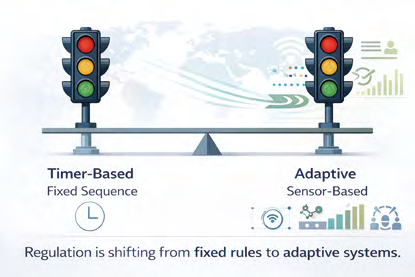
Perhaps the clearest illustration of this idea is the difference between traditional traffic lights operating on fixed timers and smart traffic systems that use sensors to adjust signal timing according to actual traffic movement. The core principle is the same: more responsive regulation, more precise decisions, and better outcomes for all.
Regulations are not drafted behind closed doors
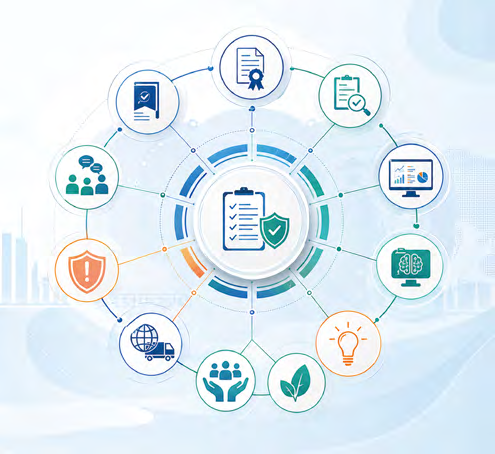
The transformation does not stop at technology; it also extends to the way regulation itself is made. Modern experience has shown that regulations designed in isolation from society are less effective, less sustainable, and more vulnerable to implementation difficulties. This is why broad public participation has become increasingly important, including the involvement of the private sector, researchers, professional associations, and consumers through digital consultation platforms, participatory models for drafting texts, evidence-based rulemaking, impact assessments, and pre-adoption testing of new regulations, culminating in what is often referred to as agile regulation. Participation not only improves the quality of regulation; it also increases compliance, reduces costs, and strengthens trust in institutions.
The essence of any smart regulation is not that it reduces requirements, but that it simplifies the path to compliance and makes implementation more efficient and less costly. For this reason, participation in building legislative rules is no longer merely an enhancement option; it has become a necessity for ensuring practical applicability, strengthening acceptance, and opening the way for innovation.
Singapore offers an advanced example through open government and policy co-design. Draft technical regulations are introduced early for public discussion, services and systems are developed in cooperation with end users, and policies are tested before formal adoption. Singapore has also developed an advanced digital model in the construction sector that allows building plans to be submitted, reviewed, and checked automatically against technical requirements, while engaging engineers and the private sector in developing the regulations themselves and using digital simulation to verify safety before implementation. Here, intelligence lies in the fact that compliance is digital, and primary review is automated, reducing licensing periods from months to days.
Similarly, in the European Union, draft legislation is published on open participatory digital platforms to receive comments from citizens, the private sector, universities, and professional organizations before adoption. In the United Kingdom, regulatory bodies are required to conduct consultations, publish impact assessment documents, and revise texts considering societal responses. These examples confirm that participatory regulation is not merely a formal appearance; it is one of the essential conditions for the quality and sustainability of regulation, because it makes it more effective, less vulnerable to misunderstanding or resistance, and more capable of practical implementation.
Smart implementation is no less important than drafting
International experience confirms that the success of technical regulations does not depend only on the quality of drafting, but also on the efficiency of implementation, the clarity of compliance mechanisms, and the ability of regulatory authorities to assess actual market impact. Smart regulation is regulation that is implemented with risk-based flexibility, subjected to periodic post-implementation review, and adjusted in light of practical results, ensuring that safety and quality objectives are achieved without creating unjustified regulatory burdens. This requires reliable data infrastructure, interoperable systems, effective data protection, and the development of human capabilities within regulatory bodies. Success here depends not on technology alone, but on data governance and evidence-based decision-making.
The GSO context: smart technical regulations in standardization and quality infrastructure
At the Gulf level, the standardization and quality system has achieved notable progress in recent years through the development of a common legislative and technical framework that is among the most advanced in the region. Harmonized Gulf standards, unified technical regulations, conformity assessment systems, the Gulf Conformity Mark (G-Mark), supporting digital infrastructure, and coordinated market surveillance programs with member states have all contributed to smoother movement of goods, reduced national duplication, stronger consumer protection, lower compliance costs, and more efficient market access across Gulf markets.
This progress does not represent the end of the journey. Rather, it lays the foundation for a new generation of smart technical regulations based on data, continuous analysis, risk-based regulation, and Gulf integration in facilitating trade and attracting investment. In this direction, the GSO Strategic Plan 2026–2030 reflects an advanced awareness of these transformations through its focus on legislative impact assessment, the development of risk analysis, digital platforms, linking regulations to data, capacity building, and strengthening stakeholder participation in drafting and development.

Conclusion: regulation as a tool of foresight, not control
Smart technical regulations in standardization are no longer simply a modern regulatory option; they have become a reflection of institutional maturity in understanding the link between regulation and development. When regulation can learn, adapt, and respond accurately to risk, it not only protects markets, but also opens them, while creating a stronger environment for innovation, investment, and competitiveness.
The world is moving not toward more regulation, but toward regulation that is more intelligent, flexible, and informed. In this shift, regulation becomes an instrument of knowledge and foresight rather than a rigid tool of control. Countries that build legislative systems based on data, participation, and continuous evaluation will be better positioned to lead future economies, strengthen competitiveness, and secure a stronger place in global value chains.
Accordingly, the move toward smart technical regulations in standardization and quality is not a narrow technical issue or a temporary digital response. It is a deeper transformation in the philosophy of regulation itself: from reaction to anticipation, from constraint to enabling growth, and from static text to a living system that learns from reality and helps shape the future.
